

April 2nd, 2026
The Apple Cart: S5, E1: How to Embrace the Four Fears of Business Ownership for Growth and Success
In this episode of the Apple Cart, I’m joined by Mark Franklin to talk about how to overcome the four fears of business ownership to grow, succeed and be happier and more fulfilled.
Mark is a transformational mindset coach, speaker and author with 20+ years’ experience helping business owners to embrace their Four Fears – the four most common mindset barriers preventing them from having the business (and life) of their dreams.®
His passion is witnessing that ‘aha moment’ in others, as they start to challenge their historic internal conversations, and start closing the gap between what they had been telling themselves they are capable of, and what they are REALLY capable of.
Be it within business or in life, Mark’s vision is to help others “write a better story for themselves and their families”.
Listen to the Interview
Why Business Owners Doubt Themselves
Any self-employed person will admit they don’t always feel confident about their own skills. In Mark’s book, he shares observing that same doubt with colleagues. So what’s the reason for it? Is it our experiences as an employee, our education or upbringing, or the ‘caveman fear’?
Mark says: “For each of us, it will vary slightly, but it’s a combination of probably all of those ingredients in the simplest terms. Our life so far is a story, and there have been all kinds of influences on us and how we feel about ourselves.
“And somewhere along the line within that story, there will be moments, event markers, where we’ve attached a meaning to something that happened or something that someone said. And we carry that meaning forward.
“It could be a throwaway thing, but we attach more meaning to it, which affects our ability to do things. We attach emotional meaning to it instead of looking at it logically. When we can shift our viewpoint and be more logical, we no longer carry that fear forward.”
What to do When You Don’t Feel Ready to Take the Next Step
Mark explains that there are two questions he asks when he’s working with a client, which are:
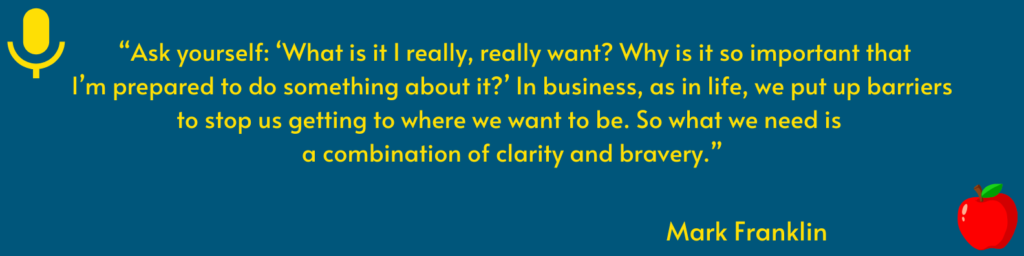
“What is it that you really, really want? And why is that so important to you that you’re prepared to do something about it? It’s a mixture of clarity and bravery, because whatever’s creating hesitation puts a barrier between where we are and where we’d like to be.
“So the clearer you are on where you would like to be, the easier it becomes to take the kind of action required to make that happen. Now, it’s not just that simple, but once you find that clarity, you can begin to put things in place and find the first step.
“It’s about exploring your why, the deep-rooted personal purpose that you have. When you come up against the barrier that stops you taking action, you can look more closely at the fear and shift and embrace it so you make progress.”
Why Mark’s Book is Interactive
Mark’s book, “The Four Fears of Business Ownership”, isn’t designed to be read in one go and then forget about it. Each chapter encourages you to reflect on what you’ve read, and there are exercises to help you do that.
“The book was always going to be interactive. You can tell people how great they are until you’re blue in the face, but they won’t change their thoughts or behaviour until they take an action. That’s what the exercises are designed to do.
“So it’s laid out so you can read something and if it resonates, pause. Do something about it that’s right for you, and then come back to it. It’s good to ask people to take the time to reflect and jot things down. It encourages us to think carefully about what we’ve just read, absorb, reflect and go on.”
The Benefits of Business Communities
Mark and I often see each other at conferences which have supportive communities attached. Mark says there are a couple of reasons they are beneficial for him. “Firstly, everyone is lovely, so you get away from the echo chamber and spend time with magical humans.
“That’s the only way I’d describe them. And that nurtures your soul and gives you energy and enthusiasm. The second is that I love stories – as a coach I listen to people’s stories to find out what’s happening for them.
“Being in those rooms means you hear all sorts of stories and learn so much. The world is changing rapidly, so I learn what’s new and what potential challenges a future client might have. And thirdly, events are a great way to challenge myself and see where I could do better.”
How to be More Creative
Mark says: “It’s such a huge question, but it’s a brilliant one. And for me, it’s what we’ve been talking about already – it’s about permission. You need to give yourself permission to be creative.
“And ‘creative’ can mean so many different things to so many different people. Running and skipping are both quite creative. It’s not just about being a great artist or a great musician or any of those sort of things.
We can be creative in so many different ways – you can be creative with spreadsheets, even! Whatever it means to you, whoever you are, whatever you enjoy doing, just give yourself permission to try something new. Lean into that just and have fun. I think creativity has got to be fun first.”
Timestamps
- 01:54 – 04:57: Mark’s previous experience
- 06:26 – 10:10: The dangers of negative self-talk
- 11:04- 13:21: Why business owners feel unsuccessful
- 14:27 – 17:30: What to do when you don’t feel ready to take the next step
- 17:52 – 20:00 Why Mark’s book is interactive
- 20:20 – 21:55: The writing process
- 22:44 – 24:18: The benefits of having a coach
- 26:57 – 28:41: Why it’s good to be part of a business community
- 32:42 – 33:36: How to be more creative
Useful Links
- Mark’s website
- Connect with Mark on LinkedIn
- Buy a copy of Mark’s book
- Interview with Susanna Reay
- Marketing conference: You Are The Media Creator Day
- Marketing conference: Atomicon