

April 16th, 2026
The Apple Cart: S5, E3: How to Stand out and be Sustainable in the Modern Business World
In this episode of the Apple Cart, I’m joined by Jason Willis-Lee to talk about how to run a sustainable small business in the modern world.
Jason Willis-Lee is a medical communications specialist with 26 years’ experience connecting patients, clinicians and researchers through clear, compassionate scientific communication.
He translates Spanish and French medical reports into accessible English and has built an engaged professional community through his niche podcast Freelancer Training on How to Find Direct Clients, where he helps freelance translators transition from low-paying agency work to premium direct relationships.
His approach focuses on premium pricing strategies, B2B relationship development, and helping freelancers escape the “race to the bottom” by targeting specialized pharmaceutical markets rather than merely competing on price.
Listen to the Interview
Using AI in Medicine
Jason says that it is a little daunting to see AI coming into medicine. “I think AI is fine, as long as a human is supervising it. From the translations of medicine to the actual practice, and it’s already pervasive in areas like radiology.
“When I was studying, we spent a long time looking at X-rays to work out what the problem was. And I’m sure most of that is automated, but you need a human to interpret the data. You can’t rely on the robot, even if it’s getting better.
“I think it’s interesting, and we probably have another couple of years of innovation and then all hell breaks loose. That’s not to say that there’ll be robots on the streets used for malicious intent, but we need to be aware of what’s happening and pivot if necessary. I did that when I couldn’t ignore machine translation any longer.”
Why Entrepreneurs Should Write a Book
Jason’s book, “How to Find More Direct Clients” was written for his community of online language service providers, which he self-published. “I found it a very iterative process. A lot of it was transcribed from audio lessons, so it needed a lot of work.
“My next book will be based on an authority framework which I built out with Susanna Reay. That’s an interesting way of moating yourself and keeping the competitors away of any business. And as Daniel Priestley says, people remember things that have names. Naming your process as a framework helps.
“I wanted to produce a practical resource. Translators are looking for actionable steps. They’re not looking for philosophy; they’re looking for plug and play things. They want to build their skillset and create leverage in their business. They need authority and to build their assets, and that’s what I help them with.”
Why a Book Helps You to Stand out
The market is changing for everyone, and all SMBs need a personal brand. Says Jason: “I think to have work you need to stand out, to be seen as a key person of influence. That’s something we can all do, and writing a book is part of that.
“For me, it functions as a way to attract people to me. But I hope that my audience can see themselves as able to do that too. To feel inspired to build the authority and the skillset that they need to go to market now.
“Having your own book is a valuable asset to enhance credibility. As well as having digital versions on various platforms, I also have physical copies I take to events. I hand them out to people and that sparks conversations. It’s good to have it in my armoury.”
The Challenges of Having a Sustainable Business
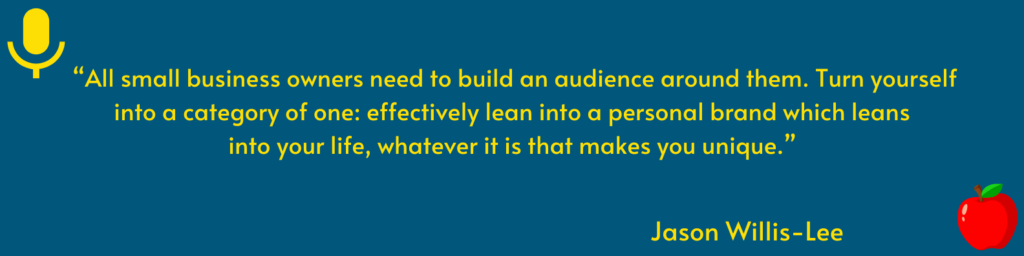
Most small business owners, Jason says, have to build an audience around them. “You have to turn yourself into a category of one. And I think you do that by effectively leaning into a personal brand which leans into your life, whatever it is that makes you unique.
“We’re seeing even with big companies a shift from business brand to personal brand. That’s what I try to teach when I work with clients one to one. I tailor my advice to the client’s personal situation and ask them what do they want from work?
“You need to agree goals together rather than work blindly. When you can guide someone is great. It requires skilling up, but that’s a worthwhile investment. You can’t build a successful business overnight, but by getting assets in place and then monetising them, like a book or a podcast, you’ll start to see results.”
How to be More Creative
“I think constraints force creativity. If you work out what your constraints are, I think that’s an interesting way of being more creative. Sometimes I get my best ideas when I’m not sitting around behind my desk. In the shower, while walking, or swimming.
“When I listen to people I admire, like Tony Robbins, it inspires me to go a bit further. I think I’m quite a creative person; I wasn’t cut out for clinical medicine, which was examining. I wasn’t emotionally up to scratch, which is partly why I left.
“Plus, I think you need to read outside your field and follow people who inspire you. I think Ryan Levesque is a wonderful entrepreneur – The Digital Contrarian. And I’d say it’s an iterative process: you can get more creative over time. There’s no excuse these days, for not being creative.”
Timestamps
- 01:37 – 03:00: How Jason got into translation
- 03:04 – 03:17: What is linguistic validation?
- 03:24 – 03:52: How Jason stays up to date with the medical field
- 09:26 – 15:36: Using AI in medicine
- 16:16 – 19:02: The process of writing a book
- 19:51 – 21:27: Why small businesses need to stand out in the market
- 21:58 – 25:20: The challenges of being a sustainable business
- 26:12 – 29:59: Why business owners should attend conferences
- 30:19 – 35:50: Life as an expat business owner
- 38:26 – 41:17: How to be more creative
Useful Links
- Visit Jason’s translation website
- Visit Jason’s website for translation business owners
- Connect with Jason on LinkedIn
- Buy Jason’s book
- Follow Jason on Instagram
- Follow Jason on X
- Like Jason on Facebook
- Follow Jason on TikTok
- Listen to Jason’s podcast
- Business coach: Tony Robbins
- Author: Ryan Levesque
- International Society for Quality of Life Research: ISOQOL
- International Society for Pharmaceutical Pharmacoeconomic Outcomes: ISPOR
- AI tool: Claude
- AI tool: MindStudio
- Marketing conference: Atomicon
- Interview with Susanna Reay