

April 30th, 2026
The Apple Cart: S5, E5: The Unexpected Positive Impact of Storytelling on Business and Life
In this episode of the Apple Cart, I’m joined by Pollie Rafferty to talk about storytelling to reframe beliefs, build relationships and change your business.
Pollie is known globally as the Speakers Storyteller, she is a neurodiverse entrepreneur, best-selling author, storyteller, international speaker, and founder of Change the Script.
Pollie discovered performance storytelling in 2004. Whilst she was overcoming crippling anxiety, she performed regularly and ran her own storytelling circle. As a lifelong learner Pollie noticed a difference with speakers that really inspired, informed and interested her, these were the storytellers!
Since then Pollie has spent years researching storytelling and Narratology. Pollie is a trained youth worker, has a diploma in narrative therapy and a psychology Cert HE.
Pollie has used her unique perspective to create Change the Script and the STAR storytelling system, teaching female speakers and women in business how to harness the power of storytelling.
Listen to the Interview
The Power of Stories
“Stories are everything, absolutely everything,” says Pollie. “We’ve been telling stories for 40,000 years, since we first developed fire. We like to know things and have our questions answered. And those become stories, things we know to be true.
“Then we learned to teach stories as educational tools to teach people how to do things, or how to behave, or how to act. Especially as society started to become more complicated, stories were still the easiest way. Now, we tell ourselves stories constantly.
“Some are good and some are bad. War and slavery have come about through storytelling. How we feel about ourselves stems from stories we heard as children – we internalise experiences we had and they become the backbone of who we are.”
The good news is, though, that we can analyse and rationalise these and reframe them into positive stories, although Pollie says it can be hard to break them, especially when they’re in the collective psyche.
The Process of Working with Pollie
If you’re not sure what it would be like to work with a professional storyteller, I asked Pollie to explain. “First, we’ll look at what you want to achieve. We need to know the end of the story before we can even start. Do you want a better connection with your audience, or overcome a personal story that’s holding you back?
“I find a lot of women have difficulty speaking in public. Not just on stage but also at networking events and talking about their businesses. It’s a subconscious thing that we tend to defer to men. So I support women to move past that feeling of imposter syndrome.
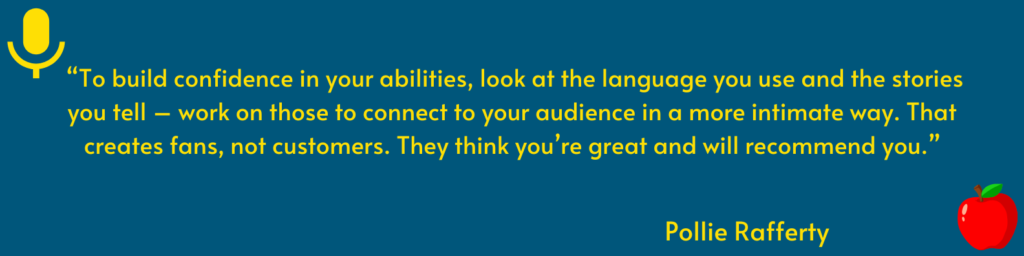
“To build confidence, look at the language you use and the stories you tell – work on those to connect to your audience in a more intimate way. That creates fans, not customers. They think you’re great and will recommend you. And the skills I teach are transferable into everyday life as well, which is why it’s so important to reframe negative stories.”
How Stories Fit in With Your Marketing
“Stories are transformational”, says Pollie, “so share stories of how your business services can transform things for customers. People want to know what’s in it for them. “They’re not interested in how much it costs, or what makes you special.
“They just want to know that you understand them, and you can help them get to where they want to be. Storytelling can help you do that. It shows them that you are the person that they need in their life to guide them to where they want to be.
“You’re the person that is going to set them on their journey to success, and you can do that through storytelling. Helping people makes us feel good, so we should make sure we make our offers clear. And never feel bad about asking for help.”
Tips for Finding Your Stories
So what if you want to get better at storytelling, but you don’t know how to find your stories? Pollie advises: “First and foremost, who do you want to tell the story to, and why? That’s always how I start. A lot of advice is, ‘Tell your origin story and why you set up your business.’
“And people don’t what know what their story is or how to tell it. Or they think, ‘Well, I set it up to make money.’ But there’s always something below that. Sometimes, that’s not even the story your audience wants to hear. So instead, think about who your ideal client is.
“Where are they now and what do they want to learn so they know you can help them? What’s the ultimate goal of your story? Knowing your ideal client and where to find them is the most important thing before you pick the story you want to tell.”
How to be More Creative
Pollie says that her ADHD brain likes to do all kinds of arts and crafts. “I’ve tried it all, so that’s my advice: give it a go. You never know what you’re going to be good at until you try it. Just don’t expect to be brilliant the first time.
“I’ve made that mistake, because my autism side goes: ‘I’m going to do this and it’ll be fantastic’ but of course it isn’t. So now I follow the advice my daughter gave me: ‘practice makes progress.’ So if there’s something you want to do but put off, go and do it.
“Get out there. Get a paint set or go to a pottery place. I also finding writing things down as if they’ve already happened can really help. Then you tell yourself that story as you drift off to sleep: “I’ve been successful in…” “I’m so pleased that I…” That positive affirmation will settle into your subconscious and you’ll start to believe it.”
Timestamps
- 02:02 – 08:20: Pollie’s past experiences
- 08:42 – 14:07: The power of stories
- 14:36 – 15:37: The process of working with Pollie
- 15:44 – 16:01: How stories fit in with your marketing
- 16:05 – 25:36: What is narrative therapy?
- 26:18 – 29:46: Tips for finding your stories
- 29:53 – 33:32: About Pollie’s books
- 33:39 – 33:52- How to be more creative
Useful Links
- Visit Pollie’s website
- Connect with Pollie on LinkedIn
- Follow Pollie on Instagram
- Like Pollie’s Facebook page
- Podcasting community: The PodRoom
- National Youth Association